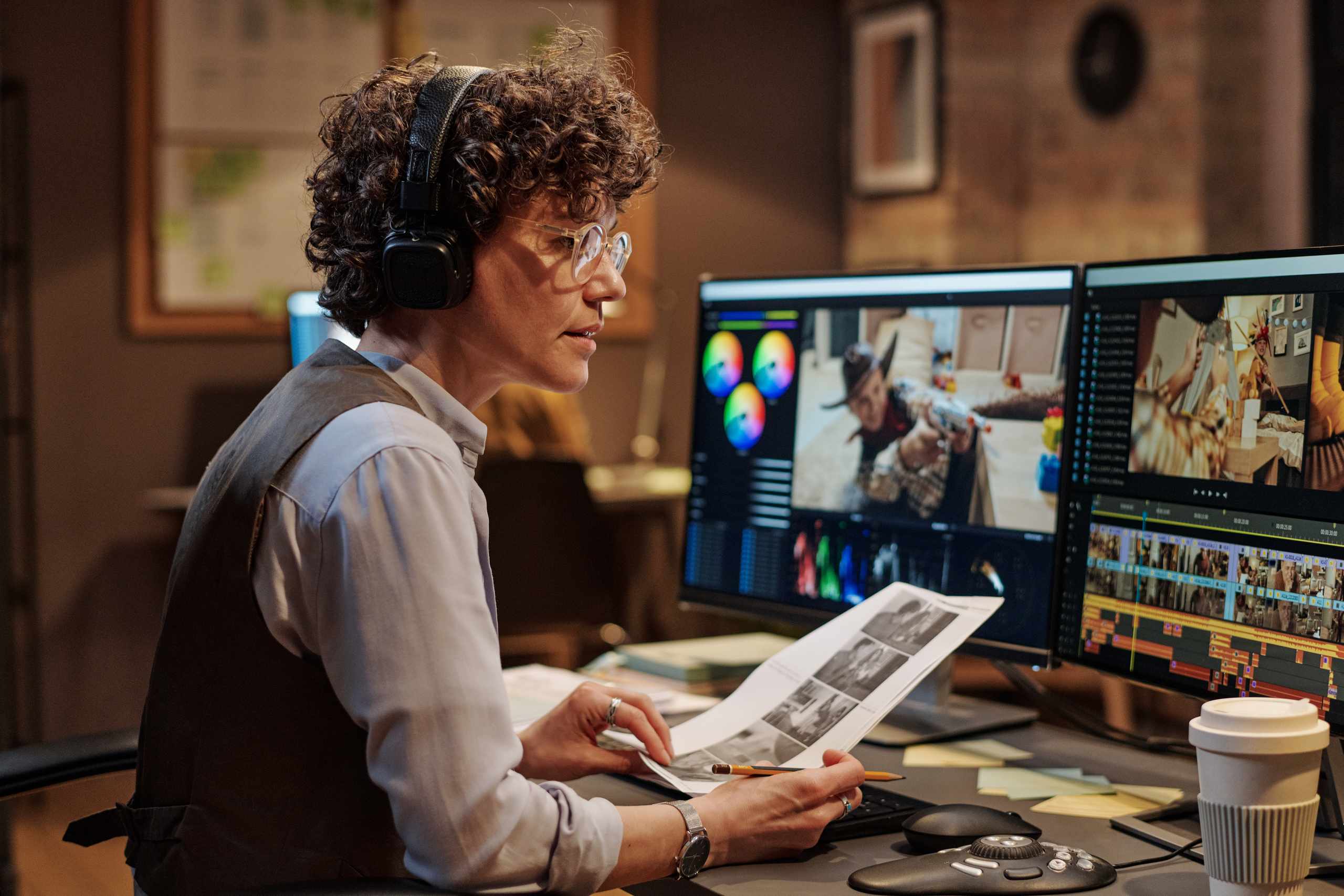
A novice opens the editing timeline with a clean slate and a clear intention, only to lose their bearings within minutes. A clip gets shortened here, a clip gets moved there, a transition gets added. Before long, the process has devolved into a series of guesses. Video editing gets better the more focused the practice is. Rather than attempt to make a complete video in every session, focus on one skill for the session. Maybe it is trimming the dead space in a piece of spoken text. Maybe it is matching up two pieces of action. Maybe it is simply leveling sound. Maybe it is making a coherent sequence of three shots: beginning, middle, and end. It is much better to have a short, highly concentrated session than to spend an hour flailing about without focus. The former makes you look for a specific kind of thing in a piece of footage; the latter doesn’t train you at all.
A good place to begin is to use a very small amount of material. Grab 5 to 10 raw clips of similar action, like walking around a few rooms in your house. Maybe they’re just a short clip of someone cooking. Maybe a cat walking across your lap. Perhaps they’re just a series of shots from a cell phone, or short clips of people moving about a park. You don’t have to make a great movie here. You need to figure out what to keep, what to get rid of. Just look at them and try to figure it out. Before you even cut, you should watch the raw clips. See how they look all together. Next, go back and start marking them, noting where interesting things happen. Is there a movement in one clip that flows into the next? Are there some cuts that look good, and some that look really awkward? Is there just more than one clip here that does something important? You have to understand that an editor’s most essential work occurs long before the first cut is made. It begins when you learn to look at a clip and see what it does in a particular context, instead of just evaluating it by itself.
A common problem in the earliest days of editing is the tendency to jump right in and start deleting the boring parts of a clip. You might end up cutting out all the pauses and breaths in a scene of dialogue, creating something that feels erratic, almost frantic. This can be easily fixed: make one rough pass at it, then play it back once, listening, and once with the screen muted, watching. When you have your eyes closed and the audio going, you can hear things that you probably wouldn’t be listening for when the clips are on the monitor. Does a piece of dialogue have time to land? Does it need more pause? Do the audio levels need adjusting? When you have your ears closed and are watching, does the action feel too fast? Does it feel jumpy in some way? Do you see yourself making a hard cut? If you do, simply give the first clip a few more frames before changing to the next one. You might find that this tiny detail solves a problem that might otherwise have caused hours of fiddling. A better editor doesn’t make more cuts in the process. They better manage how quickly they’re going.
A 15-minute editing session is very easy. Spend 3 minutes on your review and choosing one simple goal for the practice. “Let’s see if I can make some action feel like it flows smoothly from clip to clip.” Then spend 7 minutes making a rough cut with no transitions or titles or music. Then watch it 3 times over with those 5 remaining minutes. Make no changes besides timing on that one. You’re not searching for the best clip you can use, and you’re not adding effects. You’re adjusting each clip’s start and stop point. The important thing about this exercise is that often a lot of the things that feel wrong in a sequence aren’t the result of something being missing, but the result of things being too long or not long enough. Repeat this sort of exercise for a couple days throughout the week, and you’ll start to feel that the difference between a weak cut that simply joins two clips, and a good one that moves the action along, can be one simple adjustment of a cut’s timing.
When you run into trouble, don’t just jump back to the beginning. Ask yourself a better question. “Is this confusing because the clips are in the wrong order, or is it because they aren’t in long enough?” Does this feel dull because it doesn’t have audio, or does it feel dull because we’re looking at the same subject for too long? Narrowing your problem down helps you solve it more efficiently. Sometimes you can make yourself two versions. One, fast-paced and snappy; the other, more leisurely. Play them back-to-back, and watch the difference the pace makes. This kind of practice trains your eye for the subtle changes, but it also gives you an opportunity to watch two versions of the same clip. This way, when you’re just tweaking the same one for hours, you have a better reference point for what you should be doing with it.
Feedback is much more useful when it is requested in relation to one specific issue. Instead of “what do you think of my edit?” ask questions like “does the start of this scene feel clear?” or “are these cuts on action feeling right?” Even if you are practicing alone, you might write yourself a one-sentence note after every session: “This scene worked well because , but it would be improved with ” or “My next editing session should involve _.” If you work like this, the process of video editing will become a process of learning something new with each clip you work on, instead of just pushing buttons at a piece of software you aren’t very familiar with.